How to Create Product Videos That Sell in 2026 | Ecommerce Video Marketing Guide
In today’s fast-paced digital world, customers scroll through hundreds of posts, ads, and videos every day. If you want your product to stand out, a simple image is often not enough. Product videos have become one of the most effective ways to capture attention, build trust, and increase sales.
Studies consistently show that consumers are more likely to purchase a product after watching a video about it. Whether you’re running a Shopify store, selling on social media, or launching a new product, creating high-converting product videos can significantly improve your marketing results.
In this guide, you’ll learn how to create product videos that not only look great but also drive real sales.
Why Product Videos Matter
Product videos help potential customers:
- Understand how a product works
- Visualize themselves using it
- Build trust in the brand
- Make faster purchasing decisions
- Reduce uncertainty before buying
A well-made product video can increase engagement, improve conversion rates, and lower customer acquisition costs.
1. Start with a Strong Hook
The first 3 seconds determine whether viewers continue watching or scroll away.
Your video should immediately grab attention with:
- A surprising statement
- A common problem
- A bold benefit
- A visually satisfying moment
Example
Instead of:
“This is our new water bottle.”
Try:
“Tired of water bottles that leak in your bag?”
The second approach instantly creates curiosity and relevance.
2. Focus on the Problem First
People don’t buy products—they buy solutions.
Before showcasing features, highlight the problem your audience faces.
Example
If you’re selling a posture corrector:
❌ “Made from premium materials.”
✅ “Back pain after sitting all day? Here’s a simple solution.”
When customers recognize their problem, they’re more likely to pay attention to your product.
3. Show the Product in Action
One of the biggest mistakes brands make is only showing static product shots.
Instead, demonstrate:
- How the product works
- How it’s used
- The results it delivers
- Real-life scenarios
Example
For a kitchen gadget:
- Show ingredients
- Show the product being used
- Show the final result
This helps viewers understand the value instantly.
4. Highlight Benefits, Not Just Features
Features describe what a product has.
Benefits explain why customers should care.
Example
Feature:
- Battery lasts 12 hours
Benefit:
- Enjoy uninterrupted use all day without charging.
Focus on how the product improves your customer’s life.
5. Use High-Quality Visuals
Professional visuals increase trust and perceived value.
Key elements include:
- Good lighting
- Clear footage
- Stable camera movement
- Clean backgrounds
- Consistent branding
Even simple products can look premium when presented professionally.
6. Add Engaging Text Overlays
Many users watch videos without sound.
Text overlays help communicate your message quickly.
Use captions to highlight:
- Key benefits
- Product features
- Discounts
- Customer reviews
- Call-to-actions
Keep text short and easy to read.
7. Include Social Proof
People trust other customers more than brands.
Add:
- Customer testimonials
- User-generated content
- Review screenshots
- Before-and-after results
Social proof helps reduce purchase hesitation and builds credibility.
Example
“Over 10,000 happy customers.”
or
“Rated 4.9/5 by verified buyers.”
8. Keep Videos Short and Focused
Attention spans are shorter than ever.
Recommended lengths:
- Instagram Reels: 15–30 seconds
- Facebook Ads: 15–45 seconds
- TikTok Videos: 15–60 seconds
- Product Page Videos: 30–90 seconds
Remove unnecessary scenes and focus on the core message.
9. Create a Clear Call-to-Action (CTA)
Never assume viewers know what to do next.
Tell them exactly what action to take.
Examples:
- Shop Now
- Order Today
- Get Yours Before They’re Gone
- Visit Our Website
- Limited-Time Offer
A strong CTA can significantly increase conversions.
10. Optimize Videos for Different Platforms
Each platform has different requirements.
Instagram Reels
- Vertical format (9:16)
- Fast-paced editing
- Trend-based content
Facebook Ads
- Strong hook
- Clear product demonstration
- Direct CTA
TikTok
- Authentic style
- User-generated feel
- Quick storytelling
Shopify Product Pages
- Detailed demonstrations
- Trust-building content
- Customer-focused messaging
Creating platform-specific versions often performs better than using the same video everywhere.
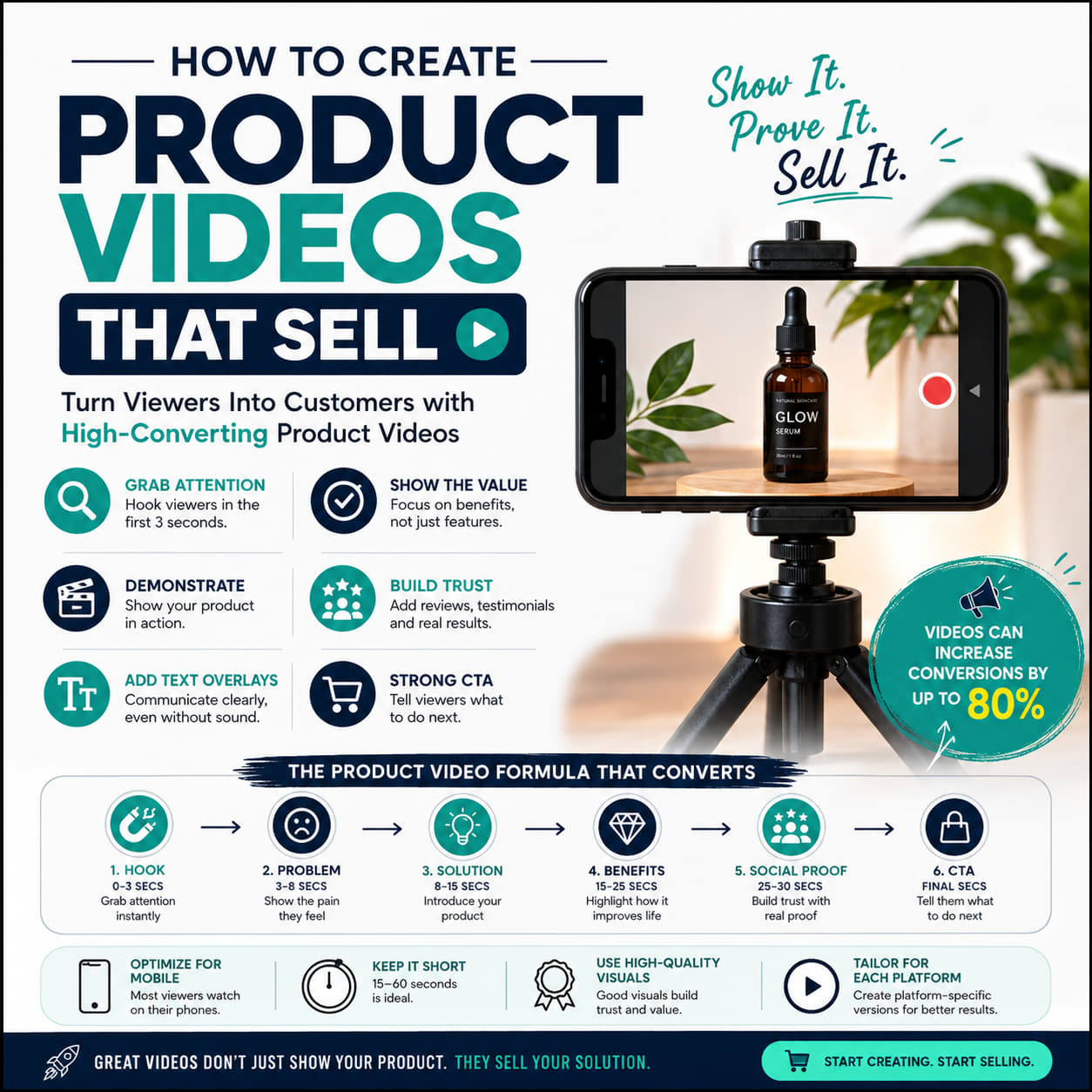
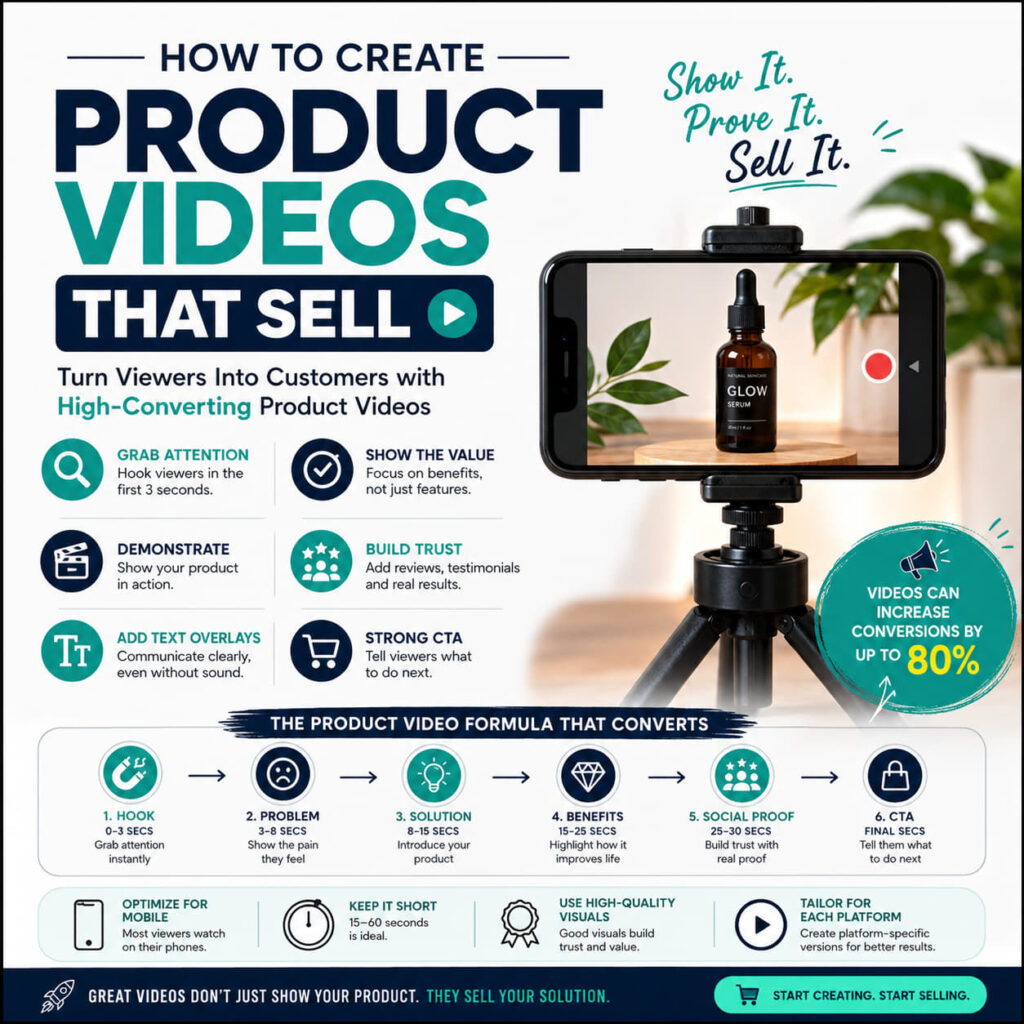
Product Video Formula That Converts
A simple structure you can follow:
Hook (0-3 seconds)
Grab attention.
Problem (3-8 seconds)
Show the customer’s pain point.
Solution (8-15 seconds)
Introduce your product.
Benefits (15-25 seconds)
Demonstrate value.
Social Proof (25-30 seconds)
Build trust.
CTA (Final Seconds)
Tell viewers what to do next.
This framework works for most ecommerce products.
Common Product Video Mistakes
Avoid these errors:
- Starting too slowly
- Showing features without benefits
- Using poor-quality visuals
- Adding too much text
- Ignoring mobile viewers
- Forgetting a CTA
- Making videos too long
Even great products can struggle if the video fails to communicate value quickly.
Final Thoughts
Creating product videos that sell isn’t about expensive equipment or complicated editing. It’s about understanding your audience, highlighting their problems, and clearly demonstrating how your product improves their lives.
Focus on strong hooks, clear product demonstrations, compelling benefits, and a powerful call-to-action. When done correctly, product videos can become one of the most profitable marketing assets for your ecommerce brand.
If you’re looking to create high-converting product videos for your store, investing in professional video production can help you stand out from competitors and turn viewers into customers.